|
|
|
|
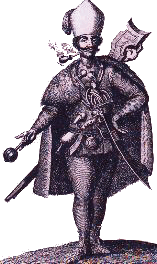
The Turkish traveler Evliya Celebi recorded in his writings that Mitrovica had been conquered by the Bosnian sandjak bey Husrev-bey. After a few short wars in which the last Serbian titular despot Pavle Bakic had lost his life, Srem and the conquered regions of Slavonia were governed by Mehmed-bey Jahiapalic. There is no reliable information about the exact date when Srem had become a particular Turkish sandjak, but a separate census of the town was taken even before 1541. At the time of mass colonization of the populations from North Serbia and North-East Bosnia in Sremska Mitrovica was restored as a town. It developed rapidly as a Turkish town and is mentioned as the seat of a kadiluk. In the census of the Christian population taken between 1S45 and 1548 it is mentioned as Kariye-i Varos Dimitrovca (Village – Town Dimitrovica). The Serbian character of Mitrovica at that time is confirmed by the information that its mayor's name was Dimitar. Until the XVI century, Mitrovica asserted itself as a Serbian town, local center of trade and crafts, but in it a Moslem djemat (parish) developed quickly which has prevailed since the middle of the XVI century. In the second half of the XVI century Mitrovica was a kasaba (borough) but it is also recorded as a large town – seher. Mitrovica was in this period not only the largest, but also the most developed settlement in Srem with a Moslem population. The progress of the town might be explained also by the fact that it was the seat of the sandjak-bey, i.e. the administrative center of the sandzak of Srem. According to the census from 1578, Mitrovica had 14 Moslem mahales (town districts) and was registered as a Turkish seher. In the same year, Stephan Gerlach noted that there were 17 mosques in Mitrovica. According to him, most of its inhabitants were Turkish soldiers, but there were also some Serbians who had no church. The development of Mitrovica depended on political circumstances prevailing in the Ottoman Empire. It progressed and stagnated in various intervals, but it always maintained the character of the important traffic and commercial center of the whole Srem. Dr Branisalav ĐURĐE |
|
SEAT OF THE HEADQUARTERS OF THE REGIMENT OF CONFINES |
|
|
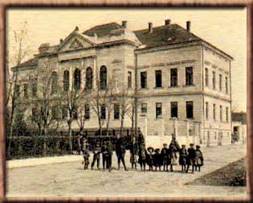
After the final expulsion of Turks from Srem. Mitrovica came, under the provisions of the Peace Treaty of Pozarevac in 1718. under the Austrian rule. Until the year 1745, it formed a part of estates of the counts Coloredo and Pejačevic and afterwards it belonged to the Military Confines of Srem as the seat of the headquarters of the regiment of Petrovaradin and of the brigade of Srem and for some time also as a free commune of the Military Confines or community. Its Serbian population was formed for the most part of immigrants from Serbia an Bosnia and the Catholic population consisted of Croats from the surroundings of Dubica an of Germans from various parts of the German Empire, in the first place from the province of Hesse. When it had been proclaimed community of Confines, in 1765, it opened the doors still wider for immigrants, particularly artisans and tradespeople (Aromuns!); therefore its population was constantly increasing and its economy, chiefly the trade, in permanent progress. As a matter of fact, a part of Mitrovica remained even at that time under the direct military jurisdiction of the headquarters of the company of the regiment and did not differ, as regards its rights and duties, from the rural settlements in the Confines. The economic development of the town and the forming of the middle class were slackened after 1787, owing to the suppression of the community and the civil municipal administration, which the citizens did not succeed in restoring in spite of many petitions addressed to the Court and material sacrifices they were prepared to make; the military administration was maintained, though its relation to the holders of »civil rights« (for the most part members of the trading and craft classes) has become later more tolerant, for such an attitude was indispensable for the development of the economy of the town and of the Military Confines. On account of its geographical situation, Mitrovica played an important role in the trade between Austria on one side and Serbia and Bosnia on the other, in which its citizens took an active part. Their export to Serbia and Bosnia was rather small in comparison with the exportation from these two provinces, and it consisted chiefly of the products of different crafts and, to some extent, also of industrial products, wine and clothes. With regard the imports it was always large, particularly, the imports of pigs and timber; on this importation were based such solid business firms as those of Bajic. Adamovic, Georgijevic and others. This trade was particularly important in the period First Serbian Insurrection; the main actor in this trade was Dimitrije Puljevic who supplied the insurgents with weapons, ammunition and victuals and exported from Serbia large amounts of pigs. In addition, the merchants rented large properties, butcher's shops and inns both in the town and in its surroundings. In the town there was a lively shop keeping and there was also an important trade with cereals, particularly with Croatia across the Sava and the Kupa. |
Seat of the Brigade - XVII-XIX century |
|
Mitrovica entered the period of the revolution in 1848 – 49 as one of the largest agglomerations in Srem (over 5,000 inhabitants) and it played a particularly important part in it. The first claims of citizens and of the inhabitants of Military Confines were rather moderate and aiming at an alliance with Croatia, but they gradually become more radical and turned more and more towards the center of the Serbian movement in Vojvodina, at Karlovci. After the Assembly of May and the attack of imperial and Hungarian armies directed at Karlovci, the movement of Serbians from Mitrovica reached its climax: the citizens and inhabitants of the Military Confines created their district committee and the national guard refused to obey the former military bureaucratic authorities and after that, towards the middle of July, in an open fight, with the use of guns, expelled the headquarters of the regiment of Petrovaradin and dispersed its officers devoted to the emperor and to the Hungarian government, who exerted a powerful influence upon the Catholic population of the town and the environments. After that, the Regiment was reorganized on a national basis, and the committees became holders of authority which had to solve many difficult problems imposed by the war, accompanied by the desertions, banditism and lawless conditions which were more marked in Srem than elsewhere in the Serbo-Croatian territory in 1848 – 49. The popular authority was maintained until summer and autumn 1849, when it was abolished and replaced by the ancient military-bureaucratic order, which was a consequence of the general victory the reaction had gained over the revolution in the Middle Danubian area. |
|