|
In the IV century in the forefront of Sirmium arose religious conflicts, first between the pagans and the Christians, which in 304, turned, into bloody clashes. The first bishop of Sirmium Irenaeus was put to death and after him also St. Demetrius, whose cult was later transferred to Saloniki. After 313, when the free profession of the Christian faith was allowed, Sirmium assumed a marked part in religious matters. The position and prestige of the bishop of Sirmium left an important place to this town in the ecclesiastical administration which reflected itself in the stirring history of the Christian church and in dogmatic conflicts in the late antiquity and in the early Middle Ages. Several councils were convoked in Sirmium to solve determined dogmatic questions among which the central place was occupied by the Arianism. An important event took place in 364, when Valentinian I and Valens divided the Roman Empire into two parts, i.e. into, the Eastern Empire and the Western Empire and a little later because of the same affair, Gratia and Theodosius I met in Sirmium. The danger of a Barbarian incursion menaced the town for several centuries and at the end of the IV century Sirmium was brought under the sway of the Goths. Later, Sirmium was again annexed to the Eastern Empire, but as early as in 441 'it was conquered by the Huns. After the Huns' conquest, Sirmium will remain for more than a century out of the reach of the government in Constantinople, being in the hands of various Barbarian tribes. |
|
|
For a short while, Sirmium was the center of the Gepide State and the king Cunimund minted golden coins in it. After 567, Byzantine Empire managed again to take possession of Sirmium, but only for a short time, because as early as in 579, the town was invested by the Avars who conquered it, after a long siege, in 582. This event marked the end of the period of late Antiquity in the history of Sirmium. For more than two centuries the fate of Sirmium was veiled with mystery. At the end of the VIII century, Sirmium probably belonged to the Frankish State of Charlemagne and from 829 – 830 the area between the Danube and the Sava was under Bulgarian rule. After having adopted Christianity, the Bulgarians restored in Sirmium, to all probability, the ancient diocese, having in mind old Christian traditions and the reputation this town had in the ancient world. The pope Hadrian II appointed Methodius as the bishop of Lower Pannonia whose seat was in Sirmium. Sirmium entered also the State of Macedonian Slavs under Samuel and in it Sermon, probably one of Samuel's noblemen, giving time resistance to the Byzantine rule. After 1018 – 1019, Sirmium is again in Byzantine hands and is mentioned as the seat of a particular diocese. Since the end of the XI century, Sirmium was entered the sphere of interests of the Hungarian State. The struggle was carried on, with a variable success, for more than a hundred years, until in 1180, after the emperor Manuel I Comnenus, the Byzantine Empire gave up for ever the territory of Srem, surrendering Sirmium to the young Hungarian State. Dr Božidar FERJANCIL |
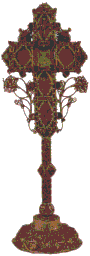
Reliquary - V century
|
|
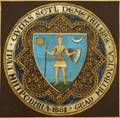
After the withdrawal of Byzantine, Sirmium also changed its political status. Within boundaries of Hungary, it was no more a frontier town and consequently was given up to a slow decay, for there were no more favorable conditions for its further development. In common with the ancient and Byzantine denominations and relations its old name also disappeared. When, in the course of the XII century there was formed a new settlement of craftsmen and merchants, it was given a new name after the old Sirmian church of St. Demetrius. The town preserved considerably longer its character of church center and the orthodox diocese of Srem existed until the end of the third decade of the XIII century. After the devastation of the region of Srem caused by the Tatar invasion the se of the diocese of Srem was transferred to Sirmium, but not to the monastery of St. Demetrius, but to the church of St. Irenaus, situated on the left bank of the Sava. Much longer than the orthodox diocese, the monastery of St. Demetrius which had become the central edifice of the old town kept up its traditions and gave a new name to the town, i.e. Civitas Sancti Demetrii. |
Right Bank of Rivar Sava - XIV century |
|
Though the monastery had remained under the jurisdiction of the Catholic archbishop, the Greek and Slav monks held on their own until the first quarter of the XIV century. In addition to St. Demetrius, for the progress of the settlement was particularly important the period of renewal and colonization after the Tatar invasion in 1241 – 1242. Before the middle of the XIV century the town was granted the privileges of a free town. In the urban area there were still preserved ancient edifices which were the property of citizens of Mitrovica. The most favorable period in the development of the town took place after the year 1358 when Dubrovnik (Ragusa) had come under the rule of Hungarian kings. This made possible the creation of the colony of Ragusean merchants at Mitrovica, about which we are informed by numerous documents from archives. In 1396, Mitrovica was for the first time burnt down and ravaged by the Turks who took away a part of its population as slaves. When the storm has blown over, the town had to rise from ashes and ruins but the colony of Ragusean merchants was never restored. For a while, about 1451, the town was in possession of the Serbian despot Djuradj Brankovic. In summer 1521 Mitrovica finally came into Turkish hands and it remained under the Turkish rule for almost two centuries. Dr Sima M. ĆIRKOVIĆ |
|